A fractional CFO is a Chief Financial Officer (CFO) who works with your business for an agreed part of the week, not as a full-time hire. Same seniority. A fraction of the week.
If you run a growing company in Singapore, you already know the gap this fills. The books get done. The GST gets filed. But nobody owns the forecast, the cash plan, or the story you take to the board.
What does fractional CFO mean?
A fractional CFO is an experienced finance leader who works with your company for part of the working week, or under a defined monthly retainer. You get CFO-level leadership: forecasting, cash management, reporting and funding support, without appointing a full-time CFO [1][2].
The whole term sits in the working arrangement. A fractional CFO is not a junior CFO, and not a cheaper qualification. The same calibre of person, engaged for the part of the week you actually need. They advise, they execute, and they own the outcomes.
It's also not a regulated title in Singapore [1][2]. No statute defines it.
That puts the weight on the written agreement. Duties, authority, days, fees and engagement status belong in writing, settled before the work starts.
In practice, the scope usually covers some or all of this [1][2]:
- Cash-flow forecasting and liquidity management
- Budgets, financial models and scenario planning
- Management and board reporting
- Fundraising, investor and bank preparation
- Financial controls and risk management
- Oversight of accounting, audit and reporting processes
- Advice on expansion, pricing, hiring and capital allocation
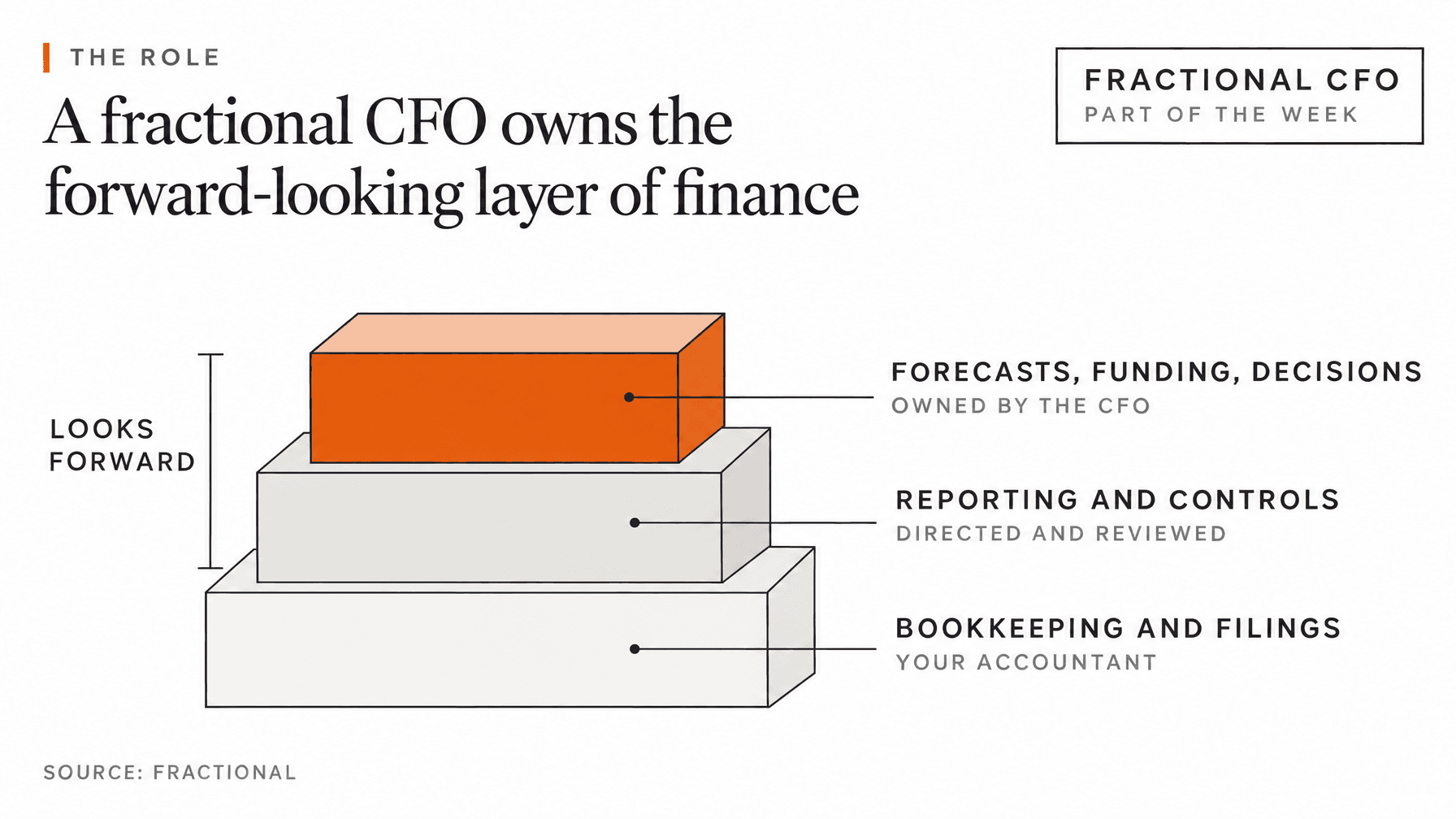
What it usually doesn't cover: transaction processing, bookkeeping and tax filings. Those stay with your accountant or finance team. The fractional CFO directs and reviews that work rather than doing it.
According to Axios, the number of LinkedIn profiles with "fractional" in the title rose from around 2,000 in 2022 to more than 142,000 by early 2025.
What is the difference between a fractional CFO and a CPA?
A Certified Public Accountant (CPA) holds an accounting qualification. A fractional CFO holds a role. One is a credential, the other a job.
The two often overlap, and many CFOs are qualified accountants. Neither title proves the other [3][4].
The practical difference is the direction of travel. Accounting work looks backwards: recording, reporting, auditing, filing. CFO work looks forwards: forecasting, funding, deciding [3].
| Fractional CFO | CPA |
|---|---|---|
What it is | A role and a working arrangement | A professional qualification |
Main focus | Forward-looking: forecasts, funding, decisions [3] | Accounting, reporting, audit, tax or compliance, depending on licence [3] |
Working pattern | Part of the week, ongoing [1][2] | Any structure: practice, industry, advisory |
What it proves | Nothing by itself; check track record | A designation, verifiable against the relevant register |
Two cautions. First, the title itself proves no qualification or registration. If the work touches regulated public-accountancy services, verify the person's credentials directly.
Second, don't overcorrect. Plenty of strong CFOs started as accountants, and some CPAs provide excellent CFO-level advisory work [3][4].
The simplest version: your accountant keeps the record straight. Your fractional CFO decides what the numbers should make you do next.
What is the difference between a fractional CFO and a consultant?
A consultant analyses a defined problem and delivers advice or a project. A fractional CFO takes continuing responsibility for part of your finance function: the forecast, the reporting rhythm, the cash plan.
One hands you a recommendation. The other stays and owns the result [1][5].
| Fractional CFO | Consultant |
|---|---|---|
Ownership | Owns recurring finance responsibilities [1][2] | Delivers a defined project or advice [5] |
Rhythm | Sits in management and board meetings [1] | Engaged for the life of the project |
Fees | Recurring retainer or agreed days [1][2] | Fixed fee or milestone based [5] |
Scope | Finance leadership and decision support | Any specialism, from strategy to operations |
The labels blur in the market. Some providers sell advisory projects under a CFO label.
The test sits in the engagement terms, not the marketing [1][5]. Does this person own recurring finance responsibilities, advise on them, or deliver a defined piece of work?
It's the question behind the scepticism you'll find in any founder forum: is a fractional CFO just an expensive consultant? Sometimes, yes. That happens when the engagement is advice dressed as leadership.
The distinction that matters is continuity. If the forecast still gets built, the board pack still lands and the cash discipline still holds month after month, you have a CFO. If everything stops when the invoice is paid, you had a consultant.
Is a fractional CFO an employee?
Not necessarily. "Fractional" describes the time commitment, not the legal relationship. In Singapore, a fractional CFO may be a part-time employee, an independent contractor, an employee of a CFO services firm, or engaged through an employer-of-record arrangement [1][6].
The structure matters because it decides who handles payroll, CPF and liability. Four common forms:
- A part-time employee on your payroll
- An independent contractor or self-employed adviser
- An employee of a services firm, supplied to your company
- An engagement run through an employer of record [6]
If the person is your employee and a Singapore Citizen or Permanent Resident, CPF contributions are generally payable [7][8]. The employer pays both the employer and employee portions to CPF Board, then deducts the employee's share from salary [7][8].
Engage the same person as a genuine contractor, and those obligations sit with them. Status follows the substance of the relationship, not the title on the email signature [1].
Whatever the structure, the written agreement should settle the following [1]:
- Who employs and pays the individual
- Working hours, supervision and reporting lines
- Exclusivity and the ability to serve other clients
- CPF, leave, payroll and statutory obligations where applicable
- Confidentiality, intellectual property and data access
- Authority to bind the company
- Termination and liability
Get this wrong and the problems surface later, at the worst moment. Get it in writing early and it never comes up again.
When a Singapore business needs a fractional CFO
Abstract definitions help nobody. Most founders we speak to are in one of these four situations.
Your finance lead has resigned
Until a permanent replacement is found and has worked out their notice, payroll, reporting and audit season still need running.
A fractional CFO holds the function together while you hire properly, then hands over clean. Far better than rushing a permanent offer to stop the bleeding.
You're scaling and the numbers are behind you
Revenue is climbing, but the forecast is a spreadsheet you rebuild the night before the board meeting. You're still approving every payment yourself.
That's the classic scale-up gap, and it's exactly what our work with scale-ups is built for.
You're preparing to raise
Investors will test your model, your metrics and your assumptions. A fractional CFO builds the financial model, prepares the data room and sits across the table in diligence.
For most SMEs, that work is intense for a season, then settles into a steadier rhythm. That shape suits a fractional engagement well.
You're running regional operations from Singapore
Singapore is a natural regional headquarters. That means multi-entity consolidation, multi-currency cash and group reporting across borders. The finance leadership that demands is senior, but not always full-time.
In all four situations, committing to a full-time package before the workload justifies it is how finance hires go wrong.
What a fractional CFO costs in Singapore
We have found no reputable public dataset of SGD fractional CFO day rates or retainer bands. What we can do is show you the full-time benchmark, the CPF mechanics, and how to compare the two honestly.
The full-time benchmark
The cleanest public benchmark is Morgan McKinley's 2026 Singapore salary data, which puts CFO roles in financial services at SGD 200,000 to SGD 500,000 a year depending on experience [9]. Treat it as an anchor, not a quote.
Benchmarks shift with sector and company size, and salary guides mix averages, medians and starting salaries, sometimes under different labels from the same publisher [10][11]. Read the label before you compare.
The CPF mechanics on top
Salary isn't the full cost. For Singapore Citizens and Permanent Residents aged 55 and below, 2026 CPF rates are 20% from the employee and 37% in total, with the employer funding the difference [7]. The employer share steps down for older employees, to 9% for those above 65 to 70 and 7.5% for those above 70 [7].
Then add the rest: bonuses, benefits, leave, recruitment fees, equipment. The gap between the headline salary and the true cost of employing a CFO is wide.
How fractional fees work
Fractional CFO engagements are typically priced as a recurring retainer or agreed days against a written scope [1][2]. You pay for the slice of CFO time you need. Where the executive is not your employee, the employer CPF share, leave and bonus that come with a salary are not part of your cost; the engagement structure, covered above, decides this.
Ask any provider to put the day count, the deliverables and the review points in writing. That document is what makes two quotes comparable.
The comparison rule is simple: compare like with like. Never salary versus invoice. It's total employment cost against total engagement cost, for the amount of CFO time you genuinely need.
Committing to a full-time package when you need a day or two a week is like leasing the whole floor when you need two desks.
| Full-time CFO | Fractional CFO |
|---|---|---|
Commitment | Permanent, full week | Agreed days or monthly retainer |
Pay basis | Salary plus CPF, bonus and benefits | Retainer against a written scope |
Statutory costs | Employer CPF, leave, payroll | Depends on the engagement structure |
Time to start | Search plus notice period | Once matched and scoped |
Best for | Large, steady finance functions | Growth-stage SMEs, transitions, raises |
Is a fractional CFO worth it?
Worth it when your problem is leadership. Not worth it when your problem is labour.
A fractional CFO is a good fit when:
- Your board or investors want reporting you cannot currently produce
- A fundraise is on the horizon and the numbers need to survive diligence
- You are scaling, and hiring, pricing and expansion decisions need modelling
- Audit, controls or regional entities have outgrown your current setup
- A vacancy needs covering while you hire without panic
It's a poor fit when:
- The books are behind. That is a bookkeeping problem, and it comes first
- You genuinely need someone five days a week. Hire full-time; the maths favours it
- Finances are simple and the business is early. A good accountant is enough
- You only need compliance filings. That is what your accountant is for
The forum sceptics have a point when the engagement is advice in a nicer wrapper. They miss the mark when the engagement carries real ownership.
A fractional CFO earns the fee in the months after month one: the forecast that keeps getting built, the board that keeps getting answers, the cash that never surprises you. Not because the model is magic, but because the seniority matches the problem.
If you're unsure which side of the line you're on, our fractional CFO readiness assessment walks through the same questions we'd ask across a desk.
How to choose fractional CFO services in Singapore
Most fractional CFO services look similar on a website. Judge any firm, including us, on six things.
Vetting depth. Who checked this person, and against what? Seniority claimed isn't seniority proven. Ask how candidates are assessed and reference-checked before they're put in front of you.
Accountability after the match. Does the firm stay involved once the engagement starts, or introduce and step away? Support, structure and governance around the executive are what separate a search partner from an introductions agency.
Time to start. A permanent hire means a search and then a notice period. Ask how quickly a curated executive can begin, and what onboarding looks like.
Notice and exit terms. If it's not working, how quickly can you exit? Flexibility is the point of the model. Terms that lock you in defeat it.
Local knowledge. CPF, GST, ACRA and IRAS rhythms, Singapore salary benchmarks, and the realities of running a regional HQ from here. A strong CV from another market isn't the same thing.
Fee structure. Scope and days in writing, a clear retainer, and no surprises. You should know exactly what each month buys.
Here's how we meet that standard. Fractional is a fractional executive search firm. Search first, fractional second.
Our collective of 1,000+ curated executives is reference-checked, and matched to your stage, sector and challenge. They embed in your business: embedded, not placed and left.
Every engagement carries support, structure and governance around it, and the executive owns the outcomes. That's what our fractional CFO service is built to do.
One sentence on AI, because founders ask: the tooling is changing fast, and navigating change is easier with leadership that has seen cycles before.
The right question is not what a CFO costs. It is what you are deciding without one. When you're ready, talk to us about hiring a fractional CFO.
Sources
- [1] Raffles Corporate Services, Fractional CFO in Singapore: When an SME Needs One: https://rafflescorporateservices.com/fractional-cfo-or-full-time-finance-hire-singapore-sme/
- [2] FA CFO, Fractional CFO vs Full-Time CFO: A Singapore Guide: https://facfo.com/fractional-cfo-vs-full-time-cfo-singapore/
- [3] NetSuite, Chief Financial Officer (CFO) Defined: Role, Responsibilities and Skills: https://www.netsuite.com.sg/portal/sg/resource/articles/accounting/chief-financial-officer-cfo.shtml
- [4] LSBF, How to Become a Chartered Accountant in Singapore: https://www.lsbf.edu.sg/blog/accountancy-and-finance/how-to-become-a-chartered-accountant-in-singapore
- [5] JDT, What Is a Fractional CFO?: https://jdt.com.sg/fractional-cfo/
- [6] EPS, Employer of Record (EOR) Services in Singapore: https://www.eps.com.sg/eor/
- [7] CPF Board, How much CPF contributions to pay: https://www.cpf.gov.sg/employer/employer-obligations/how-much-cpf-contributions-to-pay
- [8] CPF Board, Saving as an employee with CPF contributions: https://www.cpf.gov.sg/member/growing-your-savings/cpf-contributions/saving-as-an-employee
- [9] Morgan McKinley, Accounting and Finance Contract Salaries for 2026 in Singapore: https://www.morganmckinley.com/sg/salary-guide/accounting-finance/contract-salaries
- [10] Morgan McKinley, 2026 CFO Salaries for Singapore: https://www.morganmckinley.com/sg/salary-guide/data/cfo/singapore
- [11] Morgan McKinley, 2026 CFO / VP Finance Salaries for Singapore: https://www.morganmckinley.com/sg/salary-guide/data/cfo-vp-finance/singapore